
You're the decision maker now
Congrats – you earned it! But how will you know if you are doing a good job?

At some point in your career, you may find that you have become the decision maker. This is usually good news. People in your organisation will look up to you. They will come to you for advice, and then instruction. You’ll probably notice a nice bump in your bank account too, at the end of each month.
Before we celebrate too much, however, let’s pause for a minute and think about how exactly this has come about. Because the chances are that you started your career in a different kind of role. Most of us start out as producers: worker bees, making or doing something that feeds into a larger process going on around us. We don’t start off as ‘junior queen bees’, because there isn’t any such thing. (Have you ever heard of a princess bee? I haven’t. And I’m sure you wouldn’t want to be one. Nor would I.)
It’s also true, in most cases, that you won’t have done a degree in decision-making (at best, you may have taken some interesting if theoretical classes) and there is no ‘Institute of Decision Makers’ you are expected to join. It’s just generally assumed that if you did a good job on your way up the pyramid, then you will know what to do when you get to the top.
Is that a fair assumption? It’s certainly not an obvious one. So it’s reasonable to ask: how does this decision-making thing actually work? How will you know if you are doing a good job?
Let’s start with the simplest decisions, small scale choices which can easily be reversed. Most managers will make those calls on instinct, drawing on past experience but knowing that the consequences of getting it wrong are minor. There is a good literature on this, which focuses a lot (for some reason) on firefighters.1 The premise is that the more you do something, the more you train your intuitions, until you can eventually take decisions rapidly and instinctively. The more you rush into burning buildings, the more you just know what to do when you are inside one. For this kind of decision, the danger is to dither. You need to get on with it.
But what about decisions which lie outside your own experience? They might be a bit larger in scope, or they may be choices which are a bit harder to reverse. If the new situations you face are not the same as old ones, your instincts can be misleading. The danger now lies in trusting your gut feel. So the first thing you want to do is talk to some other people. Nothing helps more than a range of views. But if you find consensus, and the risks are low, you are still going to take these decisions quickly.
The harder decisions are the ones where you don’t instinctively know what to do, and nor do the people around you. This is where you need to do some research: you need to get facts on the table, including facts about what people think who lie outside your immediate network, or what experience they have had with similar situations and decisions. (I remember many years ago working on a project for a CEO who was going to have to close a call centre. So I organised a call with another CEO I knew, in a different market, who had recently closed a call centre. I think the conversation was more helpful than any of the number-crunching we produced.)
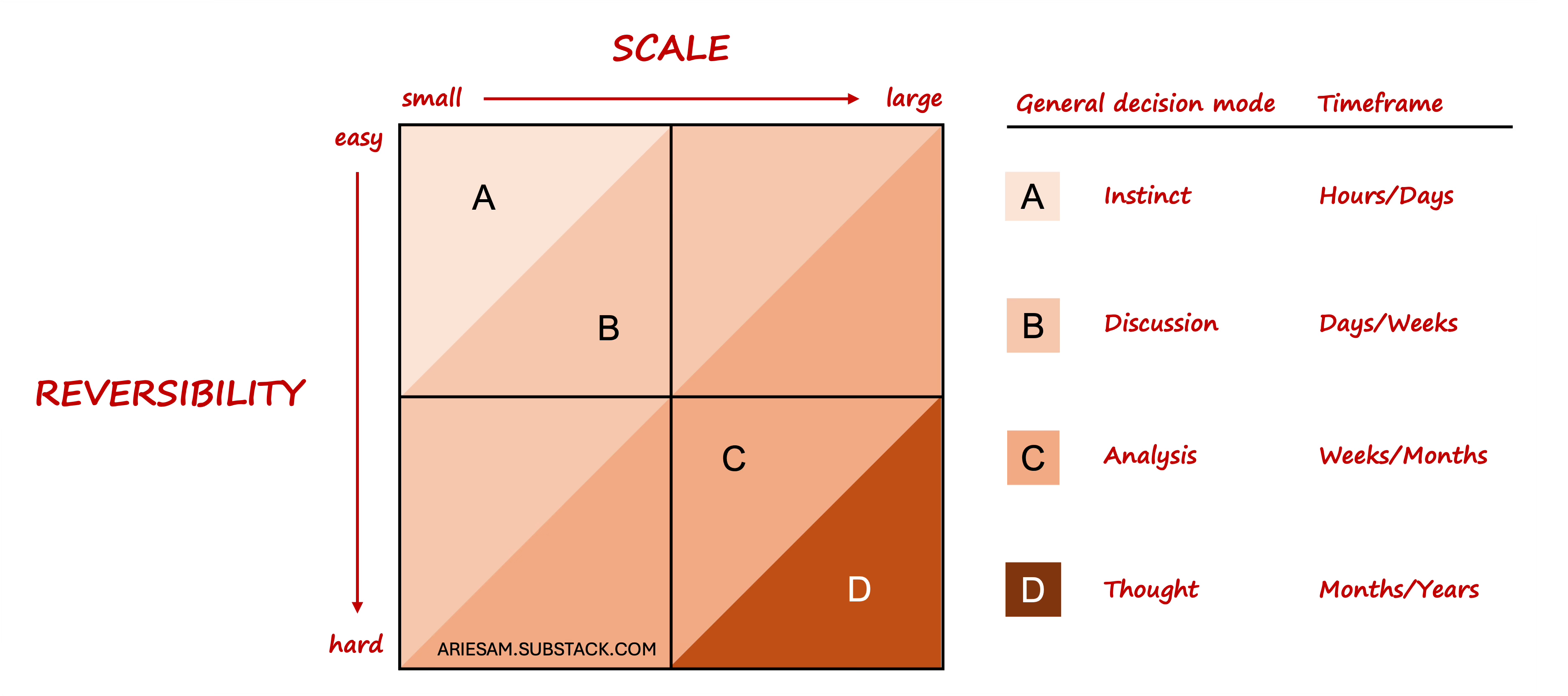
So far, so good, but we still have the hardest category left. Large scale decisions, which are hard to undo. If you are an iconic petrol car manufacturer, should you pivot your production lines entirely to electric vehicles? If you are a Swiss bank, but you sense policy evolving in a difficult way in your home market, should you move your headquarters to the US? If you are a global oil major, should you quit the Science Based Targets Initiative if it requires you to stop drilling new wells?
These are tough decisions. You would not be wise to make those calls on gut feel, after a chat with colleagues at the water-cooler, or based on a slide pack full of numbers, no matter how refined. The only way to make these decisions is with all of the above, plus a lot of careful reflection, over months, at least, and perhaps years. Jo Whitehead’s excellent and under-read book, Think Again!, reviews a long list of disastrous strategy decisions, in the corporate and public sector, and concludes that the same pattern always holds: somebody in charge has the wrong idea, and nobody stops them from pursuing it. The book sets out a number of more thoughtful decision making steps which can prevent this common pattern from unfolding.2
Once you have this framework in mind, it starts to be obvious what the success factors are going to be in this new phase of your career. One skill will be to apply the right kind of approach for the decision in front of you, and you can do worse than start with Parkinson’s law of Triviality (otherwise known as ‘bike shedding’) which says: don’t get lost in rounds of deep reflection over small decisions that don’t matter (such as where to put the bike sheds at a nuclear power plant).
But you also need to make sure you don’t put too little thought into the decisions that really do matter. The key is to be clear what kind of choice is being presented. So when the next question floats up to you for a decision, immediately ask: how much difference does this make, and (if we get the decision wrong for some reason) how hard would it be to change our minds? If you know the answers to these two questions, then you will know what you need to do next.
See e.g. Sources of Power: How people make decisions, G. Klein (MIT Press, 1999).
Finkelstein, Sydney, Jo Whitehead & Andrew Campbell. Think Again: Why Good Leaders Make Bad Decisions and How to Keep It from Happening to You. (Harvard Business Review Press, 2009)