
Electric vehicles and the parable of the magic button
A short contrarian read (4 mins) to kick off your weekend with a new idea ...

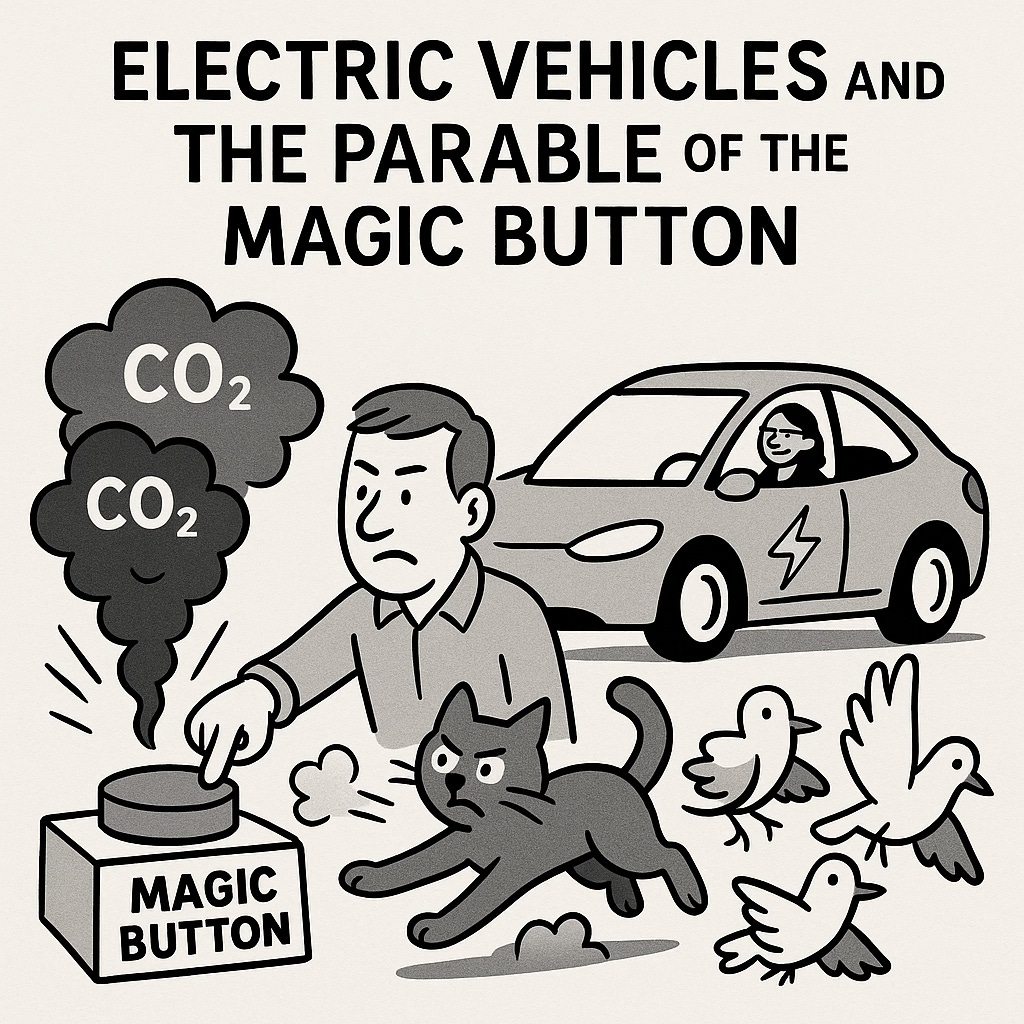
This one is a bit complicated, so let’s start with the Magic Button and come back to the electric vehicles after.
The parable goes like this: imagine a Magic Button. If you press it, a blast of extra greenhouse gases is squirted into the air. But then, over the next 10 or 20 years, if you keep the button for that long, it will slowly suck back out of the air a larger amount of pollution than it belched out at the start. So although the button initially increases our global carbon footprint, the net effect over the long term will be to reduce it.
Now – hang on a minute. Before you decide if you should press the Magic Button, I should clarify that I’m not actually 100% sure about how it really works. I mean, yes, the initial belch of gases when you first press the button is clear. But I am less sure about what exactly happens later on, because I have to make some assumptions and I don’t know if they are accurate. Still, they seem reasonable based on what I know about Magic Buttons, so I think in the long run, you know, directionally speaking, it’s likely that the Magic Button will take out more pollution than it belches out up front.
So whaddya think? Do you wanna press the Magic Button?
I’m sure it’s obvious by now that this is just another way to ask: do you want to buy an electric car? The carbon footprint of manufacturing one is higher than for a regular combustion engine car, while the carbon footprint of driving an electric car is much lower. So when you buy an electric car, you are adding to the emissions problem up front. But then when you drive the electric car, you are making a saving relative to a petrol car, and so, over time, the idea is that you will claw back the initial damage that you did.
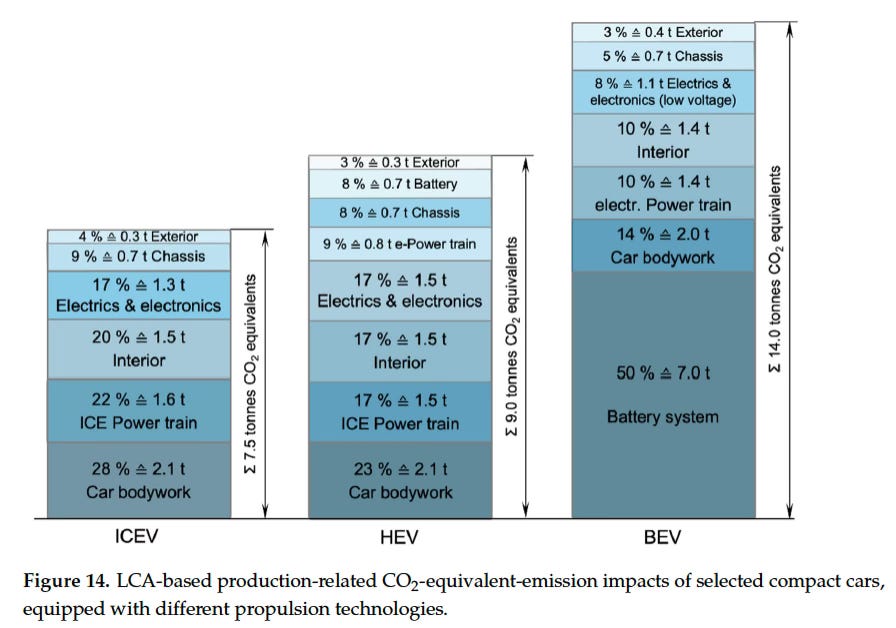
To quantify the up front emissions, here’s a chart from a recent, peer-reviewed journal article estimating the emissions from manufacturing different kinds of cars. The authors conclude that the carbon footprint of making a battery electric car is 14.0 tonnes of CO2 equivalent, compared to 7.5 tonnes for a combustion engine vehicle, so roughly double. Another peer reviewed article this year looked at the electric v. diesel models of the Peugeot 308, side by side, and found the electric model had a manufacturing footprint about double the diesel model. The difference is generally due to the battery system and its supply chain, as shown below.1
Now, to be more precise about how the extra manufacturing emissions of an electric car balance out against the lower, on-the-road emissions, we need to go back to those assumptions I mentioned. We need to take a view (for example) about how many miles you will drive each year; how clean the power supply is in the country or city where you are charging up; how long the battery lasts before you have to replace it; and what is the total lifetime mileage you can expect from the car. We could also think about some second order effects, such as whether you might drive more miles on average, if you have a less polluting car? And how much you expect your local power supply to decarbonise over the years your car is on the road.
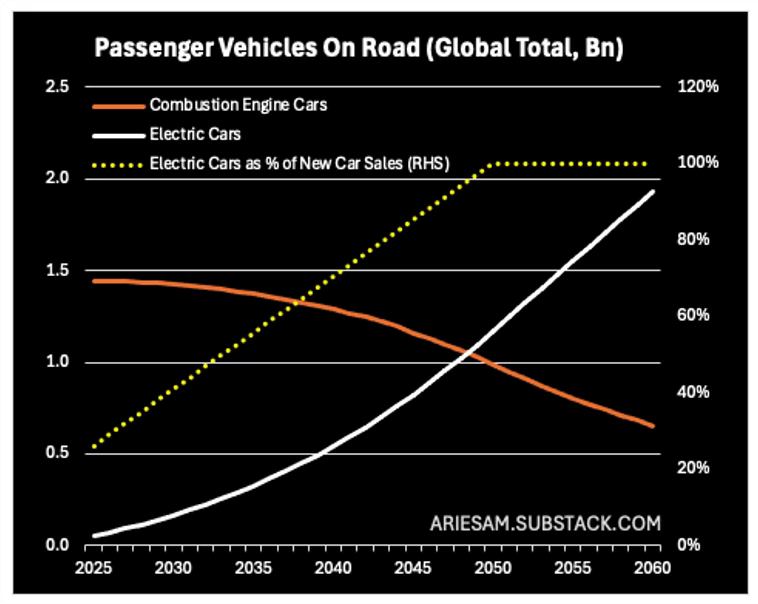
Anyway, that stuff is all quite difficult to be certain about, but I had a go this morning at a highly simplified version.2 I started by assuming that electric cars would rise in a straight line from about 20-25% of new sales in 2024, to 100% of new car sales in 2050. That’s the yellow dashed line below. And then I assumed that the total number of cars worldwide would grow at about 2% per annum over the same period, in line with real GDP but a bit more slowly than the recent auto trend. The result is a forecast which shows electric cars overtaking combustion engine cars in the late 2040s, to reach a global total of nearly 2 billion electric vehicles in the year 2060.
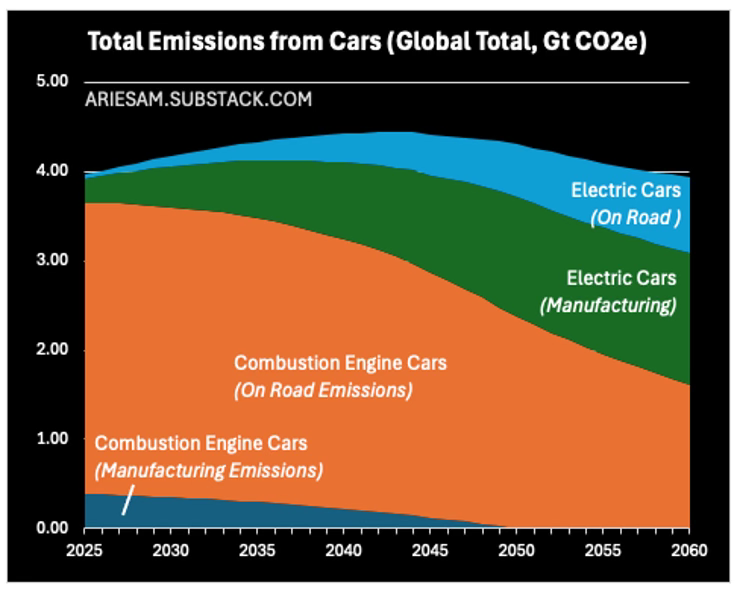
The next question is what does this mean for global emissions? Again, many assumptions are needed, but I started with the data from the journal article above, and then assumed:
The carbon footprint of EVs falls by 30% due to manufacturing improvements
The carbon footprint of grid power falls by 40% due to more renewables (etc)
The carbon footprint of ICE cars increases slightly, for both manufacturing and driving, due to the ongoing trend towards large vehicles and SUVs
With these assumptions, I get a forecast of the global carbon footprint from passenger vehicles from now to 2060 which looks like this:
CONCLUSION
So, back to the Magic Button. Press it, or don’t press it – it’s up to you. But it doesn’t look like it makes any difference to Mother Nature, not in the next 30-40 years anyway.
I don’t mean to be negative about electric vehicles. Some people love the way they drive. They may be a great solution for air pollution in urban areas. We might expect to see even higher, total greenhouse gas emissions without them. And they may be the only way we can hope to get vehicle emissions down, in absolute terms, in the period after 2060. These are all important points. I am not opposed to electric cars.
But what the Magic Button parable reminds us is that decarbonisation is always harder than it looks. In this case, even with a radical and accelerated transition to 100% electric car sales by 2050, everywhere in the world, it seems we should not expect any reduction in absolute emissions for at least another generation. And in the interim, due to the up front emissions from the battery supply chain, switching to electric cars might mean that total vehicle emissions go up not down – a classic instance of the law of unintended consequences.3
COMPLEXITY CODA
Every decarbonisation policy should have a complexity coda because what is really going to happen is never going to be as simple as you think. In this case, it seems to be that the transition to EVs will drive emissions up in the short run, and will have little to no impact over 30-40 years, except in the sense that it could have been worse.
But it’s worth saying that I have reached that conclusion just by looking at the emissions related to the vehicles themselves, in other words without factoring emissions from (a) building more power stations, to supply all the electricity the new vehicles would need; (b) building a new global network of charging points and stations; and (c) strengthening and expanding the power grid to handle the extra power volumes and the new peak demand dynamics that would come with (a) and (b).
Perhaps if you are optimistic you could argue that some of the extra emissions from building more power stations could be offset by reduced investment in the oil & gas sector. But you can’t make the same argument for the network infrastructure, at least during the years when both electric and petrol cars are on the road, because during these transition years, most countries will need to run two networks in parallel – one for refuelling and one for recharging.
A simpler way to think about this is that if the number of petrol cars on the road falls by 50%, you still need 100% of the petrol station network. Without it, how are the remaining 50% of combustion engine drivers going to fill up? But the other 50% of drivers, the ones who have switched to EVs, they will need charging facilities at home, at work, at parking spots in the city, on the motorways, and so on.4 Factoring in the added carbon footprint from having to run a refuelling and a recharging infrastructure in parallel, in every country, it might take 50 or 60 years before we see any absolute reduction in global emissions due to the transition to electric vehicles. That figure is just a guess though: I haven’t even tried to do this analysis. I don’t know how you would do it, and I have never seen anybody try.
Enjoyed this? Try these:
Advice for a college freshman (4 mins)
Our brains are not wired to understand geologic time (20 mins)
You’re the decision maker now (4 mins)
The most crowded trade in the City (5 mins)
An undiscovered Easter Egg in Stegner’s masterpiece (15 mins)
What can we learn about Britain from the plunging barley price? (4 mins)
The College Essay is dead - Long Live the ‘AI Viva’ (5 mins)
Everybody makes the same mistake in valuation (5 mins)
I don’t know if this journal article is exactly right, a lot of estimation is involved. But there are other sources with directionally similar findings: the International Energy Agency (IEA) published some data a few years ago suggesting that the carbon footprint of manufacturing a BEV is about 1/3 to 50% higher than for an ICE car, but this data is a bit older than the journal source, and there is less supporting detail. Another peer-reviewed journal from June this year looked at the electric and diesel version of the Peugeot 308, and found the carbon footprint for the electric version was 20.4 tonnes of CO2 equivalent, v. 9.6 tonnes for the diesel model. Another source is the ICCT (e.g. see their recent report here) but the difficulty we have here is that the data is presented in terms of CO2 per kilometre driven, and the ICCT report does not clearly show what lifetime mileage they assume for ICE v BEV vehicles. I suspect that they may be assuming a longer lifetime for BEV vehicles (due to fewer moving parts, etc, in an electric powertrain), which means that we cannot back out from the ICCT data what the up front, absolute emissions increase is per vehicle.
I’m not making any claims about the quality of this model. I did it quickly, and roughly. I use 200-250 g / km ICE driving emissions and 50-100 g / km for electric vehicles today. The total emissions today, around 4 GtCO2e, is similar to other estimates, although the scope may be different. I wasn’t pre-occupied with making an accurate model, more concerned to model out, in a rough cartoon form, what happens when the world transitions from a technology which is low-emission to make and high-emission to drive, to one which is high-emission to make and low-emission to drive. If anyone else has done the same exercise and has a better model, I’d love to see it.
When I tested this argument some time back with a friend who knows the auto industry, his immediate response was that the manufacturers would disagree with the estimates of the manufacturing carbon footprint. They would argue, he thought, that EVs can be made at lower carbon cost than ICE cars. If that’s right, then fine - the problem I am discussing here might melt away. But I am suspicious for obvious reasons of data from the manufacturers who are also actively selling the electric cars as a carbon reduction technology. They are evidently conflicted. So I have done my own, very simple analysis using third party and independent / peer reviewed estimates, rather than carbon communications from the OEMs (auto manufacturers) themselves.
It’s very difficult to do this analysis in detail with any kind of accuracy. But an important point of principle is that both petrol cars and electric vehicles require a refuelling network with extensive if not universal coverage, and if miles driven by either type of car goes up or down you still need to operate 100% of the network. You will find it very hard to popularise electric vehicles without putting in place a decent charging network, and equally hard to close down parts of the petrol station network while any significant number of drivers are still driving petrol cars. The implication is that for many decades of transition, when both petrol and electric vehicles are on the road, societies will need to carry the full cost of both kinds of refuelling network. Thus even if we could know that the carbon emissions of building more power generation capacity are exactly offset by reductions from developing fewer oil extraction and refining sites (which is, to say the least, unclear), it seems inevitable (a) that a transition from petrol (ICE) cars to electric vehicles emissions means an increase in emissions from the network infrastructure, and (b) the longer the transition takes, the longer you will have to run two systems in parallel, and the greater the increase in emissions due to this effect.
Thanks for sharing this, Sam. I hope we have similar magic button for ‘AI’. It will be interesting to see how AI ends up tackling the massive carbon footprint it is creating..