
We only have 5 things
And I am thinking about re-naming this newsletter after one of them.

On our rocky planet, spinning as it is through the endless void, we only really have five original resources to draw on. But the first four are not worth much without the fifth, and so I am thinking of renaming this newsletter to reflect my focus on that last, and certainly most interesting one.
Is that confusing already? For this to make sense, I better start by explaining what I think the 5 things are.
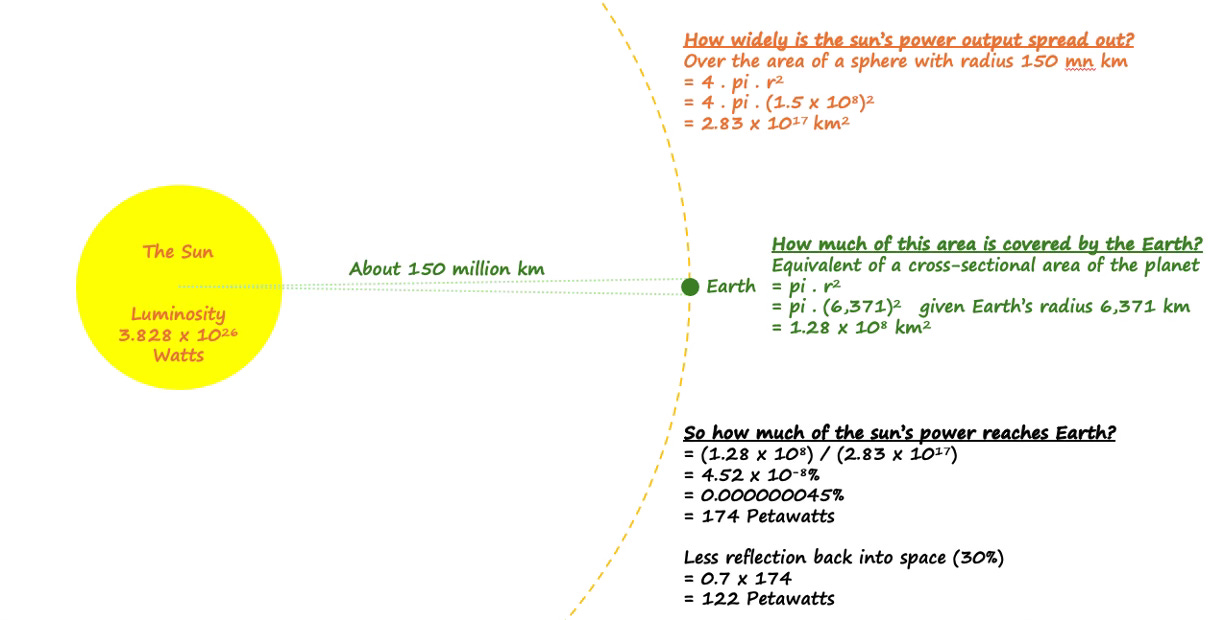
Resource Number 1 is obviously the star we orbit, the Sun, whose luminosity is about 3.8 x 1026 Watts. Fortunately we are about 150 million kilometres away from that hot, bright thing so we only pick up a tiny portion of its power, about 174 Petawatts (PW), or about half a billionth of its total power. And nearly a third of what reaches us is immediately reflected away into space again. But still, it’s illuminating to compare the resulting free power supply from the Sun (of just over 120 Petawatts) with the total, man-made power supply on Earth today – of less than 0.01 PW (i.e. all the power stations we have today, in any country, of any kind).
Ultimately, some theorise that an advanced civilisation could one day harness 100% of the power of its local star, perhaps with a barely imaginable type of stellar containment infrastructure called a Dyson Sphere. But even with the tiny fraction of the star’s power which reaches us today, the Sun is already the source of nearly all the useful energy we can lay our hands on: it’s the source of solar power, obviously, but also, if you think about it, ultimately also the source of wind, hydro, biomass, fossil fuels and animal and human muscle power too. If you keep going back upstream to the source, it almost always starts with the Sun.
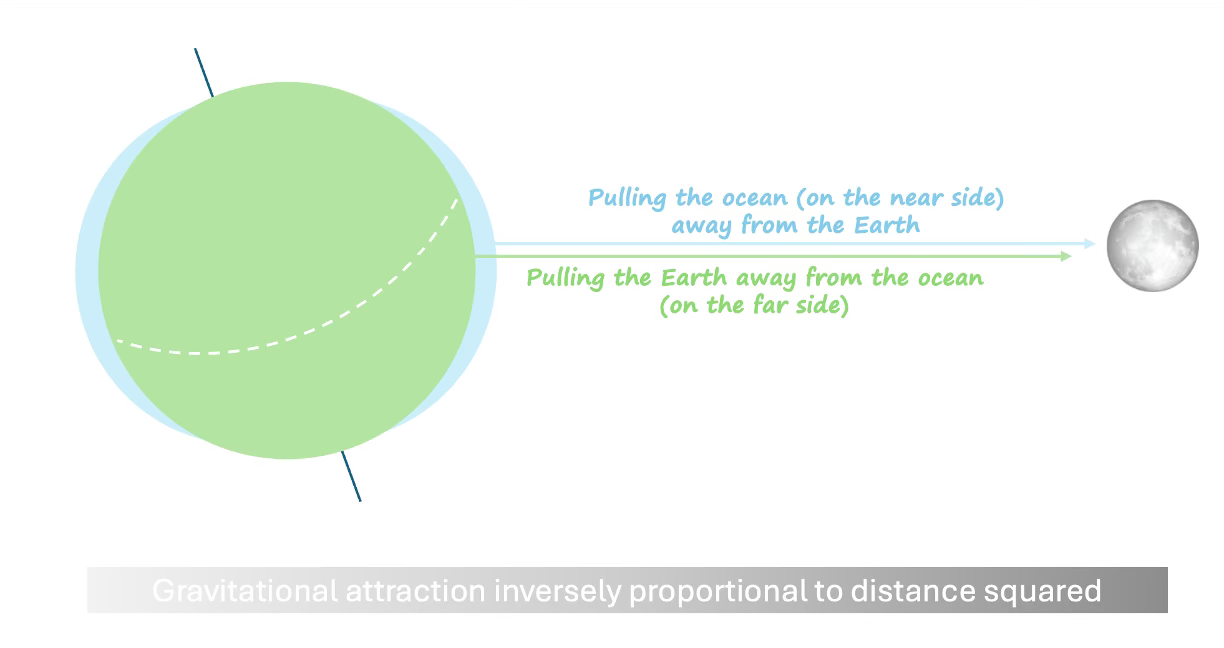
Resource Number 2 is the moon. Perhaps one day we will mine the moon for its mineral resources or move up there to inhabit its lava tubes. But until then we can benefit indirectly from its effect on our oceans. We get one tide per day thanks to the tug of the moon’s gravitational field on the oceans closest to the moon, which lifts those waters up and pulls them gently away from the basaltic ocean floor. And many places also get a second daily tide thanks to the moon’s gravity again - which also pulls the Earth slightly closer towards it, leaving the waters on the far side of the Earth a little tiny bit further away. It is poetic to think about the high tide, and how it is we who are coming and going, not the water, since if you stand on the beach for 24 hours, what’s really going on is that the spinning of the earth is rotating you in and out of the high tide zones. But in practical terms, and for our purposes here, the tides are a resource and can be harnessed for their energy, though they are very minor in comparison to the Sun.
Resource Number 3 are all the minerals and other good things stored under our feet in the Earth’s crust, which we can dig up with shovels and other more complicated kit. The continental crust itself is on average around 35 km thick (perhaps twice as thick in some uniquely elevated places, like the Tibetan Plateau) but still, we can hardly scratch the surface of it. The deepest borehole ever drilled, the Kola Superdeep, was a Cold War era project which reached a depth of 12.3km, in Russia, in 1979. It reached, in other words, only 0.2% of the way to the Earth’s centre.
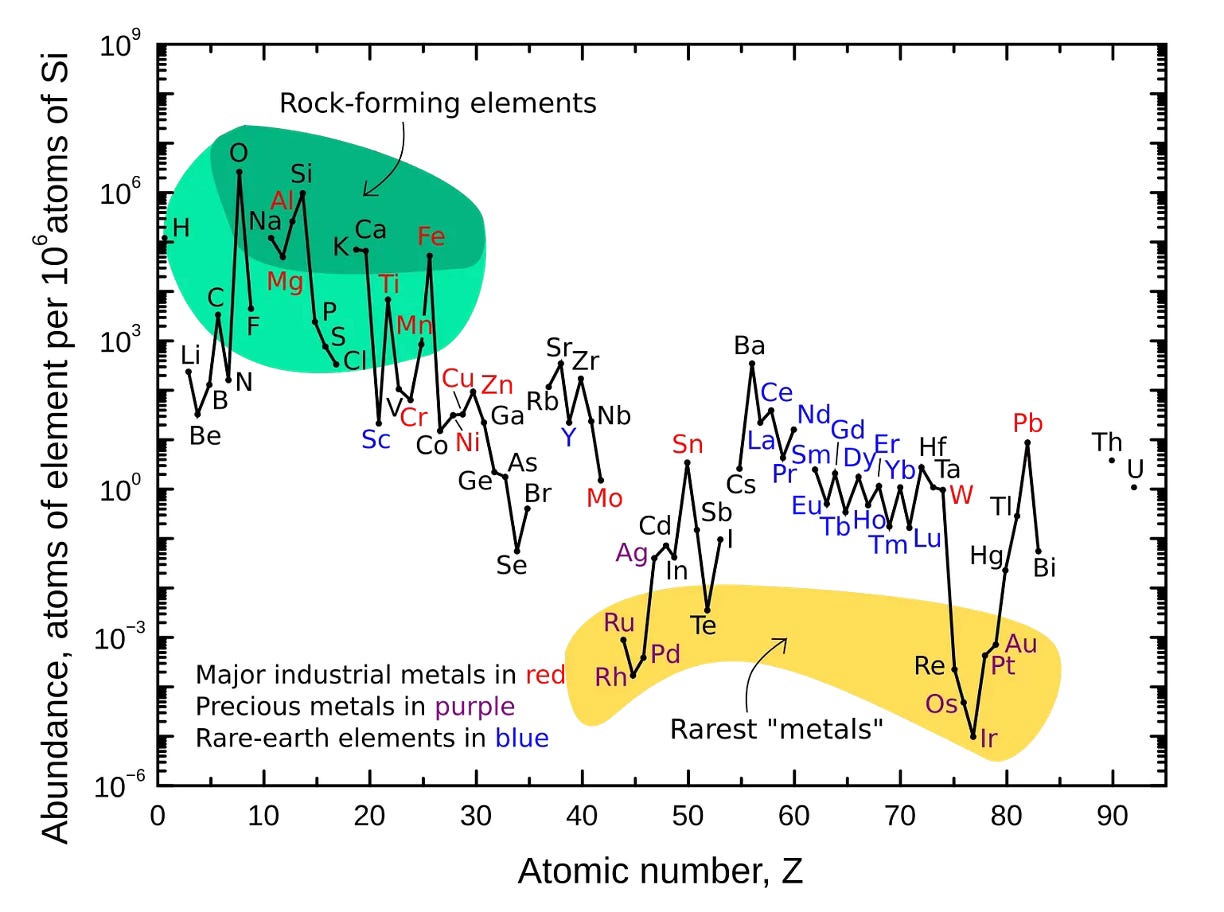
The task of going deeper quickly becomes impossible, not least because of the geothermal gradient: as a rule of thumb, the temperature rises by about 25 – 30 degrees Celsius for every additional kilometre of depth. But even from the superficial range which we can access, there comes a cornucopia of useful minerals and other substances. Most of the crust is made up of silicate compounds, so in elemental terms, about 3/4 of what we stand on is oxygen and silicon. But there is a long tail of other stuff in there for us to tap into, of which iron ore is probably the most useful. And of which Zircon crystals may be the most academically interesting.
(I guess it’s worth saying that we also have the oceanic crust, not just the continental crust, and that the oceans themselves, and the hydrosphere as a whole, and the atmosphere too, can all be thought of as containing a kind of elemental resource. So for completeness I’ll include these here, under the heading of Resource Number 3.)
Resource Number 4 is the Earth’s own heat, which is slowly being released into the atmosphere and ultimately into space. About half of this heat flow is primordial heat: residual heat accumulated from the formation of the planet from thousands of tiny planetesimals, crashing together billions of years ago and compressing to make a planet. This heat is still being released slowly back into space. And a similar sized heat flow comes from radioactive elements in the mantle, mostly uranium, thorium and potassium-40, formed not by our sun but elsewhere in the universe by stellar supernovae, aeons ago. We do, in a meaningful sense, live on a radioactive planet.
In the long view, the flow of heat from the Earth has had many benefits. It drives mantle convection and tectonic plate movements which underpin the carbon cycle and help to regulate the Earth’s atmosphere over long timeframes. Heat escaping from the Earth’s core also powers the geodynamo, creating the Earth’s magnetic field and protecting us from solar wind and other harmful cosmic radiation. But on a practical level, and over shorter time frames, the way we can tap into this resource is via geothermal energy.
So, at a high level, those are the resources we have inherited from geology and physics, and to some extent from dumb luck. So what, then, is Resource Number 5?
Resource Number 5, in my opinion, is our perhaps unlimited ability to come up with new ideas about what to do with the other four resources. From the point of view of an economist, it’s the production function. From the point of view of an artist, it’s the imagination. In the very broadest sense, it’s technology. But in all cases, it’s the wonderful and improbable ability of our species to conjure up combinations of thought which lead to completely new and original ways of doing things.
It’s the ability to heat a pint of milk to 72 degrees, for 15 seconds, and cool it down again immediately, just to prevent that pint of milk from giving you tuberculosis. It’s the ability to theorise the difference between a convergent and a divergent mathematical series in order to build suspension bridges which don’t fall down. It’s the ability to write numbers on a piece of specially printed paper; define that paper as a store of value; and have millions of people use that trick to cumulate the value of their daily efforts and break out of the prison of agricultural day labour.

In other words, the fifth resource is our creative ability for insight, invention and improvement. For me, it is the most interesting resource of them all – and since it’s the theme which unites all the different things I am writing about on this page, I will change the title of the newsletter to reflect that somehow. I only have one last problem to solve: a good idea for the new title. I guess it will come to me eventually.
Enjoyed this? Try these:
Electric Vehicles and the Parable of the Magic Button (5 mins)
Advice for a college freshman (4 mins)
Our brains are not wired to understand geologic time (20 mins)
You’re the decision maker now (4 mins)
The most crowded trade in the City (5 mins)
An undiscovered Easter Egg in Stegner’s masterpiece (15 mins)
What can we learn about Britain from the plunging barley price? (4 mins)
The College Essay is dead - Long Live the ‘AI Viva’ (5 mins)