
Every cloud has a sulphur lining
A look at the unexpected positives after IMO talks failed last week – and the 'first ever global carbon tax' was delayed by at least another year

If this article was forwarded to you by email, you can join the free mailing list at ariesam.substack.com. If you are already on the list, thank you – and you will notice that I changed the name last week (from ‘Sam Arie on Substack’ to ‘In Search of Good Ideas’). I’ll explain more about that in the next post.
Among the eye-catching concepts taught in an introductory economics class is the idea of the public good. A public good is non-excludable (if it’s good for someone, it’s good for everyone) and non-rivalrous (your enjoyment of it doesn’t diminish mine, and vice versa).1 The classic examples are national defence – and clean air.
Reviewing this concept in class, some decades ago, I was asked to come up with an example of a public bad. When I hesitated, a student called out: ‘what about… stray bullets?’ An interesting thought, because if there are stray bullets out there, they are certainly a danger to us all. And if there are very many stray bullets, then my being hit by one of them doesn’t reduce the chance that you could be too. But still, let’s agree, the concept was being stretched.
A far, far simpler example of a public bad would have been: air pollution.
There are many ways the air can be polluted, but among the most serious problems are sulphate aerosols which are linked to acid rain, ozone depletion and a range of respiratory health conditions. And a major source of those aerosols are sulphur dioxide emissions from the shipping industry, which runs on bunker fuel - a low-cost, high-sulphur version of crude oil. It would not be bending the facts too far to say that bunker fuel is, effectively, whatever is left behind after the process of fractional distillation has been used to skim off the higher value products (kerosene, diesel, and so on). Bunker fuel is the leftovers, and it’s filthy stuff.
Given all this, you would be forgiven for thinking that efforts to reduce the use of bunker fuel – such as the talks which collapsed last week in London and had been expected to introduce the world’s first, global carbon tax – are an exclusively good thing. But as is so often the case in environmental matters, the story is not so simple.
In this case, a silver lining needs to be taken into account because sulphate aerosols have a surprising positive effect on our climate: they contribute to cloud seeding and albedo, and thereby increase the reflection of solar radiation back into space. In other words, years of aerosol pollution linked to sulphur dioxide emissions have actually cooled the planet and significantly offset warming from other sources, as the following chart shows:
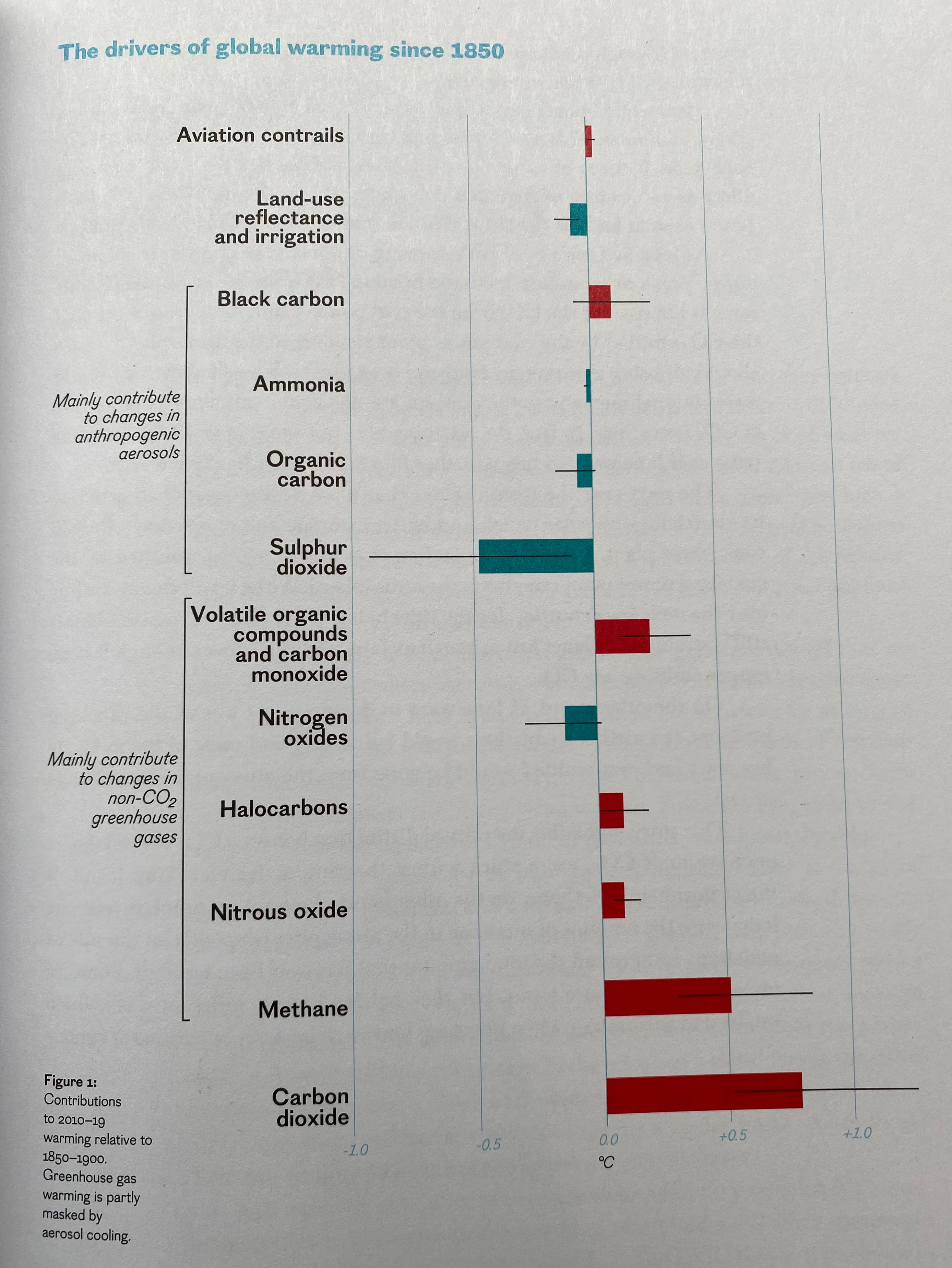
This chart confirms that aerosol pollution due to sulphur dioxide emissions has masked the extent of underlying global warming by about half a degree, on our best estimates. So if we were able to remove all those aerosol pollutants from the air, we would reveal a ‘true’ global warming effect which is already far above the 1.5 degree stretch target of the Paris agreement, and perhaps already at, or very close to, the fallback target of 2 degrees.
Indeed, studies are starting to show that this ‘unmasking’ effect is taking place already. New regulations from the IMO (International Maritime Organisation) which came into force in 2020 have already reduced the permitted sulphur content in bunker fuel from 3.5% to 0.5% and, as anticipated above, it appears that the short term effect has been to increase global temperatures. A peer-reviewed article (in a Nature portfolio journal last year) suggested that the new regulations on bunker fuel may explain most of the strong warming trend in the early 2020s. The authors concluded as follows:
In 2020, fuel regulations abruptly reduced the emission of sulfur dioxide from international shipping by about 80% and created an inadvertent geoengineering termination shock with global impact. … The amount of radiative forcing could lead to a doubling (or more) of the warming rate in the 2020 s compared with the rate since 1980 … The warming effect is consistent with the recent observed strong warming in 2023 and expected to make the 2020s anomalously warm. The forcing is equivalent in magnitude to 80% of the measured increase in planetary heat uptake since 2020.
Source: Yuan, T., Song, H., Oreopoulos, L. et al. Abrupt reduction in shipping emission as an inadvertent geoengineering termination shock produces substantial radiative warming. Commun Earth Environ 5, 281 (2024).
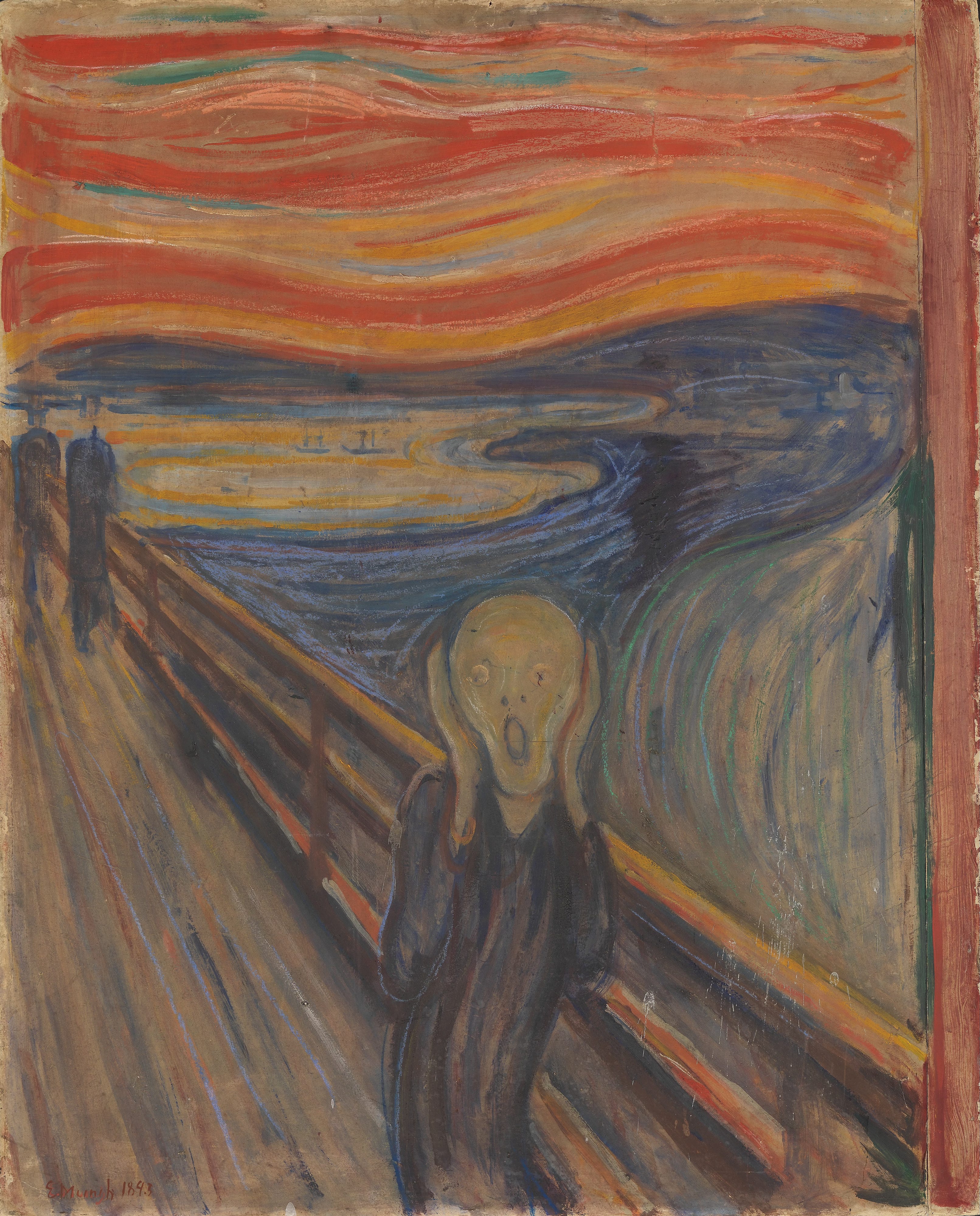
If you are an environmentalist, this is the kind of unintended consequence which makes you want to scream. But that’s not why I added Munch’s famous painting at the top of this article. That picture is there to highlight another kind of public good that comes from sulphur dioxide pollution: incredible sunsets.
The “volcanic sunset” in the background of The Scream (1893) has been attributed to Munch’s memory of the extraordinary Scandinavian sunsets that followed the eruption of Krakatoa in 1883, which blasted something up to 20 million tonnes of sulphur dioxide into the world’s skies. In certain regions, the sulphur dioxide mixed with water vapour to produce a fine mist of aerosol droplets, essentially droplets of sulphuric acid, which scattered and refracted the evening sunlight to produce the brilliant red and orange twilights which Munch later painted.
“I was walking along the road with two friends—then the Sun set”, Munch wrote in his diary, and “all at once the sky became blood red—and I felt overcome with melancholy. I stood still and leaned against the railing, dead tired—clouds like blood and tongues of fire hung above the blue-black fjord and the city. My friends went on, and I stood alone, trembling with anxiety. I felt a great, unending scream piercing through nature.”2
If it seems far fetched to say that Munch’s painting was inspired by aerosol pollution, it’s worth knowing that another peer reviewed paper, this time from Atmospheric Chemistry and Physics (ACP), has shown that volcanic sunsets can indeed be seen in the works of other artists over a 400 year period from 1500 to 1900 (including Rubens, Renoir, Turner, Corot, Klimt, Bosch and many others). The most sensational painted sunsets, it is clear from the data, come soon after the most violent volcanic eruptions – and there is sufficient consistency to reconstruct a half-decent historical index of aerosol levels from colour analysis of the paintings alone.
So it seems that the cloud of air pollution has an unexpected, second silver lining: if we do continue pumping the atmosphere full of sulphur dioxide, then never mind what other harm that may do – there will at least be some remarkable sunsets to see.
Enjoyed this? Try these:
We only have 5 things (5 mins)
Electric Vehicles and the Parable of the Magic Button (5 mins)
Advice for a college freshman (4 mins)
Our brains are not wired to understand geologic time (20 mins)
You’re the decision maker now (4 mins)
The most crowded trade in the City (5 mins)
An undiscovered Easter Egg in Stegner’s masterpiece (15 mins)
What can we learn about Britain from the plunging barley price? (4 mins)
The College Essay is dead - Long Live the ‘AI Viva’ (5 mins)
Everybody makes the same mistake in valuation (5 mins)
Non-rivalrous is quite an unusual word. Most of us never see it in any context other than the definition of a public good. But it’s interesting to look at where the concept of rivalry comes from: originally from rivus, the latin word for a stream, or perhaps from ripa, the riverbank (although the people behind this short video say that rivus and ripa come from entirely different roots). But either way, your rival is someone who has access to your water supply, and by definition (yikes) one of you is upstream from the other. Little good can come of that. Your companion, on the other hand, is the one you share your bread with (cum panem), with a more auspicious implication.
Source: Munch’s diary entry, 22 January 1892, cited here.