
Life advice – from chess
(3 minute read)

If you like this article, you can help by sharing it with someone else. And if someone forwarded this to you, you can join the free mailing list here.
An old joke about chess is that it only takes two things to win: first, have a plan to checkmate your opponent; and second, know how your opponent plans to checkmate you.
It’s a nice line. And thanks to the Keats heuristic, we tend to think that apparently symmetrical statements like that must contain wisdom. But the reality is that it’s bad advice, since for most of a game of chess, you won’t actually have a checkmate plan. And nor will your opponent.
The reason is that the game is long, and there are too many different ways it can unfold. In fact, although the board is small and the rules fixed, determining how many ways a game of chess can go turns out to be a difficult mathematical problem – and may not even have an answer. A 1950 paper by Claude Shannon estimated a total of 10120 possible games, and this number (known as the Shannon Number) is very, very large: it far exceeds, for example, the total number of atoms in the observable universe (thought to be somewhere around 1080). 1
As a result, even the latest chess computers don’t try to win by calculating all the possible moves, and even the best human players don’t often look more than 7 or 8 moves ahead.2 Actually that too is a difficult number to estimate, and discussion on chess forums suggest the true number may be 4-6 moves, or even lower (2-3 moves). Players only report thinking through 10+ moves when they are engaged in a critical, tactical battle, and usually at much later stages in the game (when the tree of possible moves has fewer branches).
What does this tell us about life? Well …. life is long, the dimensions of the board are not fixed, and there are no rules. At almost any age, there are more life paths open to you than you can, or do, imagine. Young people are often asked about their life plans, and it’s very natural for the rest of us to ask ‘where would you like to be in 10 or 20 years?’ But for most of them it’s an impossible question. We may be able to look around the next corner, or even the next corner after that. But do any of us really know where life might take us in 10 or 20 years? Hardly.
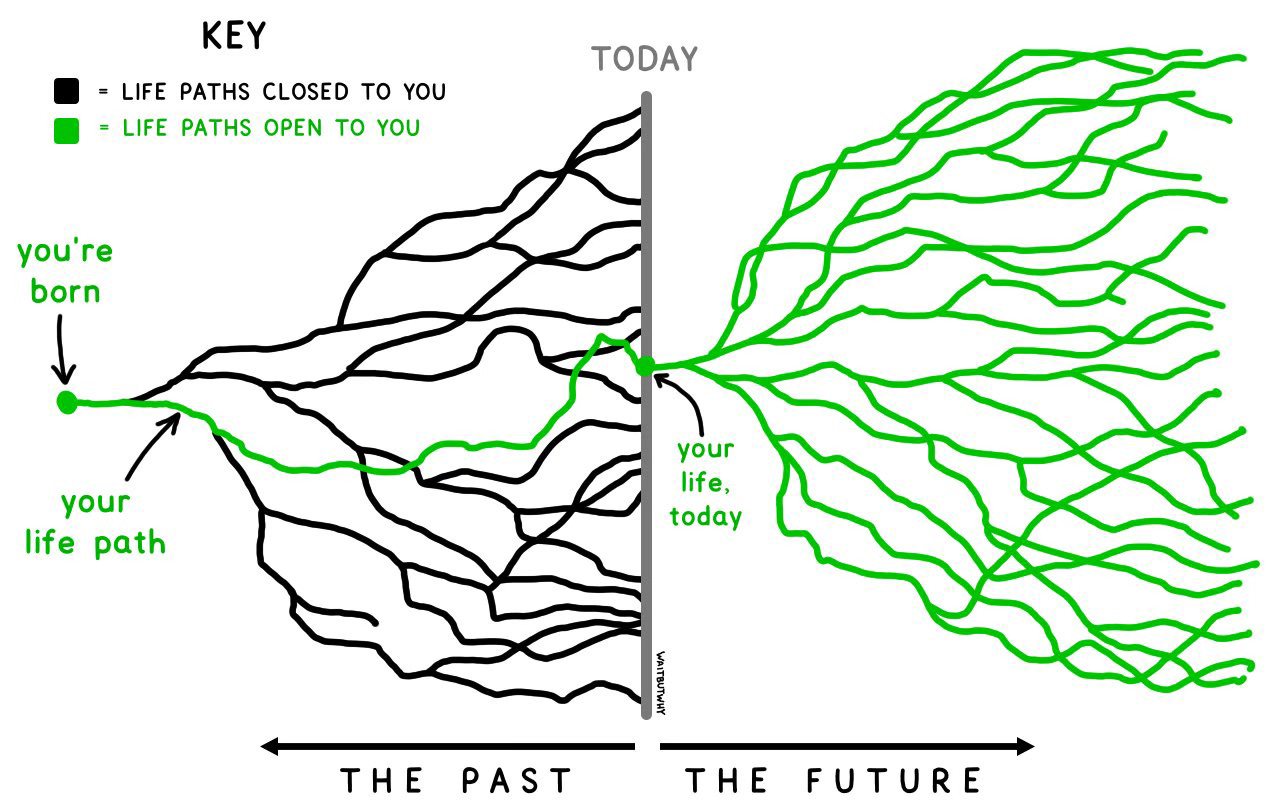
So how does a chess player deal with this problem? She focuses on making good moves for now. There are some common rules of thumb which can help define a good move, e.g. castle early, and don’t leave your pieces hanging (i.e. unprotected by another piece). And it is true that your objectives will change in predictable ways as you move through the different stages of the game: the opening, mid-game or endgame. In the opening, develop your pieces. In the mid-game, take control the centre of the board. In the endgame, focus on how to close it out. These can be useful guidelines.
But the principle is always to keep building your position. Make sure that each move adds something to what you have done so far. The contrast is a revealing study in behavioural economics which asked participants to assemble Lego bionicles for a fee per completed toy. The question was how long would the study participants keep going? And there were two experimental subgroups, one named Meaningful and one named Sisyphus. The rules for each subgroup were as follows:
In the Meaningful condition, after the subject would build each Bionicle, he would place it on the desk in front of him, and the experimenter would give him a new box with new Bionicle pieces. Hence, as the session progressed, the completed Bionicles would accumulate on the desk.
In the Sisyphus condition, there were only two boxes. After the subject completed the first Bionicle and began working on the second, the experimenter would disassemble the first Bionicle into pieces and place the pieces back into the box. Hence, the Bionicles could not accumulate; after the second Bionicle, the subject was always rebuilding previously assembled pieces that had been taken apart by the experimenter. This was the only difference between the two conditions.
Ariely, D., Kamenica, E., & Prelec, D. (2008). Man’s search for meaning: The case of Legos. Journal of Economic Behavior & Organization, 67(3-4), 671-677.3
The results were exactly as you would expect: participants in the Sisyphus group abandoned the task much sooner than those in the Meaningful group. It is discouraging to put effort into something and then see your work dismantled. It’s like leaving your pieces hanging in chess - and then watching your opponent take them off the board.4
So in life, if you feel stuck, or you are not sure of your direction, the best advice I know is to dial back your horizons. Don’t worry too much about how the board is going to unfold in the far future. Just focus on developing your pieces and see what happens next. Your opponent could make an unexpected mistake, as Deep Blue did in the famous first game against Kasparov in 1997. Or your opponent could resign when they didn’t need to, as Kasparov then did (even more famously) in the second game. You just never know.
The key is to keep going. Be ready to be on the receiving end of an opportunity, whenever one comes along, or to take a calculated risk. As Simonides once observed: excellence dwells on summits which are hard to reach.5 And you can’t get up there without a climb, and probably a bit of a scramble, so just keep going. Keep gaining altitude with each step. Keep building your position.
Enjoyed this? Try these
The dumbest thing a Congressman said (12 mins)
The House Always Wins (5 mins)
The power of a pure idea: #1 - The Finger Space (10 mins)
Every cloud has a sulphur lining (5 mins)
We only have 5 things (5 mins)
Electric Vehicles and the Parable of the Magic Button (5 mins)
Advice for a college freshman (4 mins)
Our brains are not wired to understand geologic time (20 mins)
You’re the decision maker now (4 mins)
The most crowded trade in the City (5 mins)
An undiscovered Easter Egg in Stegner’s masterpiece (15 mins)
What we learn about Britain from the plunging barley price (4 mins)
The College Essay is dead - Long Live the ‘AI Viva’ (5 mins)
Everybody makes the same mistake in valuation (5 mins)
Credit to Nate Silver for this comparison, which comes from the chapter below.
In Chapter 9 of The Signal and the Noise: Why So Many Predictions Fail—But Some Don’t by Nate Silver. Penguin Press, 2012.
I know that some of the classic Ariely studies have been doubted recently - part of the mini-scandal that rocked the behavioural science sector (See e.g. They studied dishonesty - was their work a lie?. But as far as I know, nobody has cast doubt on this rather brilliant one.
Just to be clear: it can often be valuable to make a deliberate trade, even an adverse trade (in terms of the value of the pieces) in exchange for board position. The point here is not to leave your pieces hanging without realising what you are doing.
Fragment of Simonides of Ceos (6th - 5th century BCE): ἔστι τις λόγος / τὰν Ἀρετὰν ναίειν δυσαμβάτοισ᾽ ἐπὶ πέτραις. (Enjoy the Doric dialect! I have translated it loosely, but you get the idea.)