
NATO and 1984
Will Ukraine be betrayed by doublethink and boiled rabbits?

A 10-minute read on the issue of our times. If this was forwarded to you, you can sign up at ariesam.substack.com to have articles sent to your own inbox. Slava Ukraini.
I - IF RUSSIA WINS
Last week, in an airport, I bought a short book: If Russia Wins: A Scenario (Atlantic Books, 2025) by Carlo Masala, Professor of International Politics at the Bundeswehr University in Munich.
And then, on a short flight, I read it.
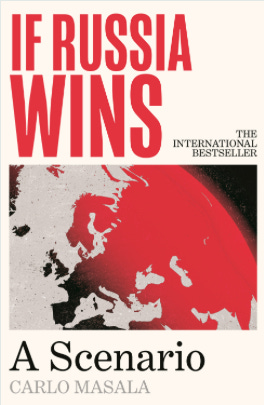
What this provocative book describes, sometimes with vivid details, is a scenario in which Russia succeeds in exposing NATO’s Article 5 to be little more than a bluff. The book extrapolates from today’s situation on the ground in Ukraine through a sequence of more or less surprising developments.
Among the less surprising ideas is that Russia’s next move would be a military incursion into one of the Baltic states, ostensibly to protect Russian-speaking minority populations there. Among the more surprising ideas, perhaps, is the idea that President Putin would resign, installing a new Russian leader and confusing the West about his intentions, while continuing to pull strings in the background.
The endgame is that Russia succeeds in neutralising NATO, essentially for two reasons: firstly, because the US withdraws, washing its hands of security commitments in Europe; and secondly, because the European nations fail to step in and fill the gap this creates. Arguments are made in both directions but eventually - at least in the Masala scenario - the appeaseniks win the day. NATO lacks the will to act. Russia wins.
II - 1984
The other book I read last week is George Orwell’s post-war masterpiece, 1984. I should have read it years ago, I know, but I am catching up.
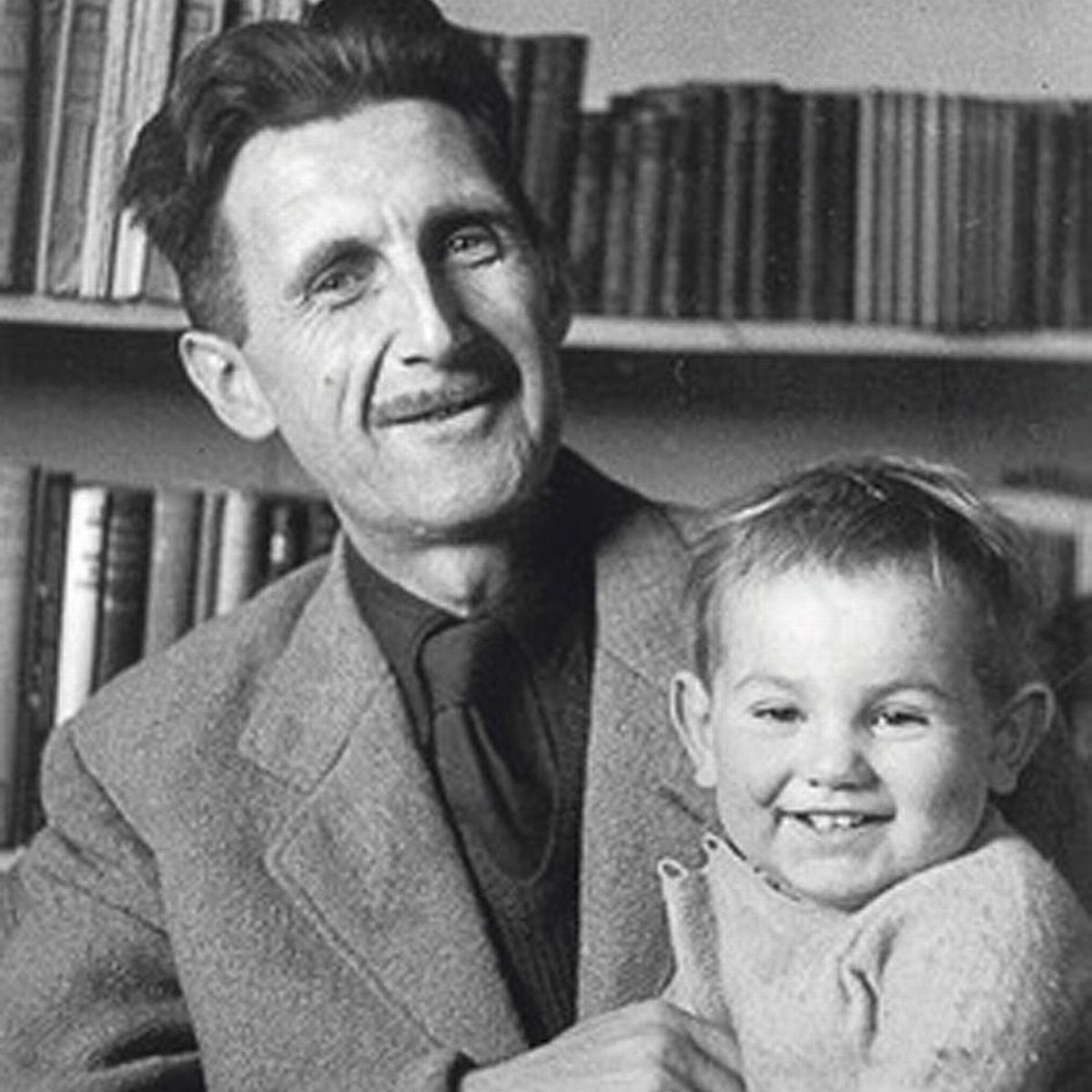
1984 was written between 1947 and 1948. One explanation for the title is that Orwell simply reversed the numbers in “48” to give “84”, and chose that year for his futuristic projection. But another explanation is that he looked ahead to a time when his adoptive son, Richard Blair, born in 1944, would have grown to be a similar age as Orwell himself, at the time of writing the novel. And what he anticipates in his son’s lifetime is, quite simply, a world tugged loose from all its moorings.
In the imagined and deeply dystopian future, the newly created region of Oceania is governed by ‘The Party’ (and its unseen leader, ‘Big Brother’) under a totalitarian ethos seemingly reflecting a blend of Stalin’s Russia with Hitler’s Germany.
Life in Oceania is bleak. The Party is committed to the eradication of individual expression and complete allegiance to doctrine, even when the doctrine is nonsensical. It is a woeful portrait of the future, but Orwell’s achievement is not simply to articulate the misery of the individual in such a system. Although he does tell that story, through the decline and fall of his obdurate protagonist Winston Smith, he does not come close to what later writers (Solzhenitsyn, or Grossman for example) were able to describe - drawing on their own, extreme experiences at the edge of what a human can endure.
Instead, Orwell’s accomplishment was to capture the political nihilism of a state architecture which has abandoned the pursuit of truth in favour of the pursuit of total power and complete control. In the early chapters of the book, Smith writes in his illicit diary that freedom is the freedom to say that 2 plus 2 equals 4, but later, during his torture and re-education in the Ministry of Love, he will be taught that 2 plus 2 may equal 5, or indeed whatever The Party wishes it to equal.
In a revealing passage, Orwell articulates a debate between Smith and O’Brien, the Inner Party member who administers the re-education. O’Brien is explaining how the Party achieves mind control, arguing that control over material things is trivial in comparison. Smith responds that surely control over matter is not trivial, and that the Party for example has no control of the stars. The passage continues:
“What are the stars?” said O’Brien indifferently. “They are bits of fire a few kilometers away. We could reach them if we wanted to. Or we could blot them out. The earth is the center of the universe. The sun and the stars go round it.”
Winston made another convulsive movement. This time he did not say anything. O’Brien continued as though answering a spoken objection:
“For certain purposes, of course, that is not true. When we navigate the ocean, or when we predict an eclipse, we often find it convenient to assume that the earth goes round the sun and that the stars are millions upon millions of kilometers away. But what of it? Do you suppose it is beyond us to produce a dual system of astronomy? The stars can be near or distant, according as we need them. Do you suppose our mathematicians are unequal to that? Have you forgotten doublethink?”
1984, Part 3, Section 3
This passage is important because it confirms, as Winston has feared all along, that Party doctrine has moved beyond truth and into fabrication. But it also goes further, articulating the Orwellian concept of doublethink, the requirement to believe contrary ideas at the same time, which is essential to the party’s particular model of mental oppression. It is not just that Party doctrine may be false. The point is that the doctrine is constantly shifting, inconsistent, and at odds with itself. To follow the Party, like Smith’s ill-fated neighbour Parsons1, you must be ready to believe that 2 plus 2 equal 5. Or 1. Or zero. Or all of the above, or whatever you are told, and once you know, you must believe with all your mind that this has always been the case. That is the essence of doublethink.
And it is this concept which allows Orwell to take his novel to its darkest depths, where nothing is as it seems. For Smith - and Julia, his lover - are indeed captured and interrogated by O’Brien who accuses them of joining a secretive resistance movement known as ‘The Brotherhood’. But how did our protagonists come to join the Brotherhood? The answer is that O’Brien invited them to join it.
And it is here that the fog of doublethink swirls most thickly. In an earlier section of the novel, Smith had sensed an ally in O’Brien; O’Brien found an excuse to invite Smith, and Julia, to his home; O’Brien introduced the couple to the resistance, and enrolled them. But very shortly afterward, the couple are arrested, incarcerated and Smith will discover that the very same character, O’Brien, is now his captor.
Just as we never meet Big Brother (and it is left unclear if he is a real figure, or a fabrication), likewise we never meet the Brotherhood. It is left unclear if there is a real resistance, or if the Brotherhood exists only as a fabrication - a device to entrap the likes of Smith and Julia. But what is made perfectly clear is that our protagonists do not simply join the resistance. They are enrolled into the resistance by the very Party they seek to overthrow, and then they are arrested for disobeying the Party by enrolling. The fog swirls thickly again here, the doublethink is deep.
It is worth asking why such narrative complexity is needed, but the answer is obvious. The cycle which is created is as follows:
—> Hope. O’Brien allows Winston to believe he has found an ally. They become comrades. They drink wine and exchange secret codes.
—> Commitment. Winston commits to the brotherhood, feels for a moment that he can be part of something larger, dares to dream of a new reality, and takes new steps to further his resistance.
—> Betrayal. Winston discovers he has been set up. O’Brien is his tormentor, not his protector. The Brotherhood may not even exist. The commitment was futile. Dismayed, Smith is ready to be broken.
This now is the signature soundtrack of 1984, and reminds us of the aphorism that the busiest time for family lawyers is Monday morning, and the first day back in January after the Christmas break. For partners trapped in difficult marriages, the weekend, or the Christmas holidays bring hope; there is an opportunity to repair, rebuild, to commit to each other and to try again; but if the commitment fails and the weekend or holidays are spent in conflict, then it feels like a deeper form of betrayal. Discouraged by the futility of failed effort, the broken couple picks up the phone on Monday morning.
This is the psychological dynamic which O’Brien exploits in Smith, and underlines that Orwell is not, I don’t think, interested to describe the physical failures, shortages and hardships of the party state, although those things do feature in the novel as a backdrop to the action. What Orwell is at pains to show is how The Party destroys resistance, and how by doing so The Party can break and remake the mind.
‘They can make you say anything—anything—but they can’t make you believe it’, Julia says to Winston one day, before they are arrested. ‘They can’t get inside you.’
But she is wrong. They can get inside you. And they do.
III - BOILED RABBITS
In an influential essay, Thomas Pynchon has described Orwell's frustration that 1984 was often taken to be simply a critique of Communist Russia. Pynchon reports that Orwell rejected that idea: he did not want Big Brother and Goldstein to be read as allegories for Stalin and Trotsky, even if some readers were tempted to take that view after reading Animal Farm (published in 1945, a few years earlier than 1984). Instead, it seems that Orwell wanted 1984 to be read as a broader critique, and a warning of the perils lurking in our own, Western societies.
In this sense, Orwell pitted himself as much against the pacifists of the far left as the dictators of the far right. In a 1940 essay, My Country Right or Left, he berated the far left as ‘boiled rabbits’ and lamented their refusal to see the inevitability of war playing out across Europe - and their unwillingness to fight for survival. He wrote of “the spiritual need for patriotism and the military values, for which, however little the boiled rabbits of the Left may like them, no substitute has yet been found”.2
Orwell hated the idea of war, and had experienced its realities in the 1930s, fighting the fascists in Spain, where he had caught a nearly fatal sniper bullet in the neck. But as his essays and novels show, he was always clear about what was worth fighting for, and why. And this in turn brings us to the question of where we should look to find the contemporary Oceania? Where, in today’s world, do we look to find the world which 1984 describes?
My conclusion is that we do not find Orwell’s Oceania in modern day Russia. Yes, the Russian government may fabricate history, lie to its own population, challenge and provoke its adversaries and exert a brutal level of control over its own citizens. And yes, contemporary Russia is bellicose towards its neighbours as the Masala scenario predicts. And yes, all these points can be seen as parallels with Orwell’s Oceania.
But Orwell’s Oceania was not Russia. 1984 is set in London, and Oceania is in fact an imagined future coalition of the United States and the United Kingdom, separated somehow from the other regional spheres of Eurasia and Eastasia. So when Orwell was writing about Oceania, he was explicitly writing about the West. He was not asking us to pour scorn on the dictatorships of far flung nations. He was writing about the potential for darkness of the same kind to emerge from within our own societies.
IV - HOPE, COMMITMENT & BETRAYAL
Yuval Noah Harari has argued that Ukraine is winning the war. His picture of the battlefield is one of Ukrainian success, holding back a larger and more powerful adversary in the most extreme conditions. He sees the Ukrainian army, with a million battle-hardened men and women, as Europe’s most important resource in the defence against Russian aggression. He resists the narrative that Russia is getting what it wants.
Well, it seems to me that he is perhaps half right. Right to see the enormous value of the Ukrainian army, whose endurance against the odds has fast become the stuff of modern legend. But he is just as surely wrong to see Ukraine as having the upper hand. The Ukrainians have had great successes. But battlefields are similar to financial markets in at least one important respect: every year, and sometimes every day, the clock resets. Your successes yesterday are worth little if you are going backwards today. And as of today, Ukraine is going backwards on the battlefield, and backwards in diplomacy too.
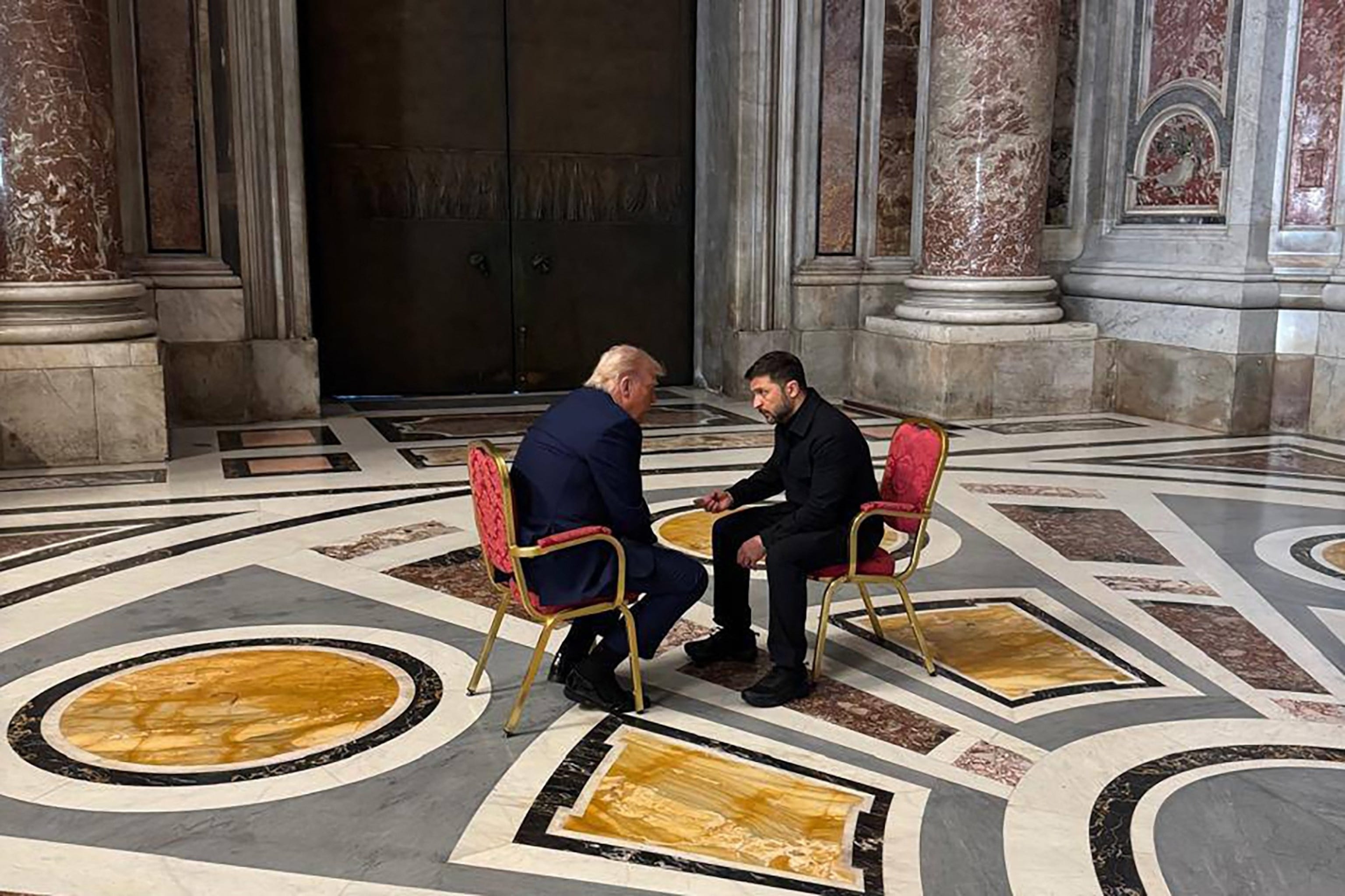
Ukraine is going backwards in diplomacy because Trump’s America has finally turned. After the February showdown in the Oval Office, the April meeting between Trump and Zelenskyy at the Vatican created the hope that America was back on board. Intelligence support and arms sales were reinstated, US messages to Russia appeared to sharpen, and Ukraine redoubled its defensive efforts.
The Orwellian cycle, in other words, from hope to commitment to eventual betrayal was already under way. In the end, little more than 6 months was needed before the betrayal came - in the form of a peace plan which few saw as anything less than a capitulation, even in its revised and softened form. Phillips P. OBrien, Professor of Strategic Studies at St Andrews, and who has as far as I know no relation of the O’Brien character in 19843, has argued - in his recent essay The Long Con Comes To An End - that this was always Trump’s plan, and that all the talk of ratcheting up pressure on Russia was simply for show.
He has argued, in other words, that Trump is Zelensky’s tormentor as much as he is his protector. He has painted a picture, to my mind, of Trump as Orwell’s O’Brien, inviting Zelenskyy to join the Brotherhood, only to reveal that no such Brotherhood exists - and to launch a prosecution. So when I look at the iconic image of the Vatican meeting, copied below, I do not think of the Nobel Peace Prize. Instead I think of O’Brien and Smith in 1984, and I think of the Orwellian cycle. Hope —> Commitment —> Betrayal.
V - HOW IT ENDS
I would like to believe that the future will not play out as Masala describes, but the evidence at this point is against me. Since the start of the Ukraine war in 2022, NATO and the West have been fearful of escalation and at every step NATO and the West have taken the minimum action. From tanks and planes to cash and sanctions, the West has helped, but always cautiously and to the minimum possible degree. Russia’s threats of nuclear action have been heard. NATO has not wanted to call Russia’s bluff by taking any action perceived to be an escalation.
NATO’s response, in other words, has followed something like the exact opposite of the Powell Doctrine, which stated that “when a nation is engaging in war, every resource and tool should be used to achieve decisive force against the enemy, minimising casualties, and ending the conflict quickly by forcing the weaker force to capitulate”. 4
Instead, NATO has pursued slow and obsessively incremental and proportionate responses, never providing decisive force. NATO has, if you like, provided indecisive force. And through this approach, NATO countries have given Russia time to regroup; time to recover from military mis-steps at the start of the campaign; time to adjust to sanctions; and time to rebuild diplomatic relations with other nations, including China and India. It seems clear now that the proportional and incremental response has probably made things worse; resulted in greater casualties; prolonged the war; and likely degraded the best negotiated peace agreement Ukraine can hope to achieve one day.
NATO has allowed itself, in other words, to believe it is united in resolve and that it is exerting maximum pressure on the adversary, while in reality the pressure it has been exerting is low. NATO has allowed itself, in other words, to believe in an Orwellian doublethink in which it has been (i) tough on Russia; (ii) soft on Russia; and (iii) not even clear what exactly its stance is on Russia, all at the same time. For NATO, the stars may be near or far, according as we need them. Or as Pynchon said, returning to his essay on doublethink:
“This is nothing new, of course. We all do it. In social psychology it has long been known as “cognitive dissonance.” Others like to call it “compartmentalisation.” Some, famously F Scott Fitzgerald, have considered it evidence of genius. For Walt Whitman (”Do I contradict myself? Very well, I contradict myself”) it was being large and containing multitudes, for American aphorist Yogi Berra it was coming to a fork in the road and taking it, for Schrödinger’s cat, it was the quantum paradox of being alive and dead at the same time.”
The Road to 1984, Thomas Pynchon, The Guardian (2003)
NATO has displayed all this: cognitive dissonance; arriving at a fork in the road and taking it; contradicting itself; being alive and dead at the same time; and taken in the round, this is the reason why the likeliest scenario now looks to be a Russian victory. Ukraine’s defeat looks to be as total as Winston Smith’s, as he sits, re-educated, in the Chestnut Tree Cafe, drinking Victory Gin and waiting for the final bullet to come.
Because NATO cannot win, and not win, and not take a position, all at the same time.
Because NATO cannot be at war with Russia, and not at war, and not clear if there is a war, all at the same time.
Because NATO cannot provide a robust deterrent while being the one who is deterred from acting robustly.
None of those contortions amount to a military doctrine.
They are, for want of a better word, a modern form of doublethink.
Enjoyed this? Try these
Cosmic Principle No. 1 (5 mins)
Is the AI bubble bursting now? (15 mins)
The Bad Good Idea (5 mins)
Bill Gates and Point Break (10 mins)
Life advice - from chess (5 mins)
The dumbest thing a Congressman said (12 mins)
The House Always Wins (5 mins)
The power of a pure idea: #1 - The Finger Space (10 mins)
Every cloud has a sulphur lining (5 mins)
We only have 5 things (5 mins)
Electric Vehicles and the Parable of the Magic Button (5 mins)
Advice for a college freshman (4 mins)
Our brains are not wired to understand geologic time (20 mins)
You’re the decision maker now (4 mins)
The most crowded trade in the City (5 mins)
An undiscovered Easter Egg in Stegner’s masterpiece (15 mins)
What we learn about Britain from the plunging barley price (4 mins)
The College Essay is dead - Long Live the ‘AI Viva’ (5 mins)
Everybody makes the same mistake in valuation (5 mins)

A cadre who is unthinkingly faithful to the party, but eventually reported to the authorities by his own children, for words spoken in his sleep. Smith meets him while awaiting interrogation in the Ministry of Love.
My Country, Right and Left (1940) coins the useful phrase ‘boiled rabbits’.
How is that half of the important people in this section are named O’Brien? That is just one of those things which the world throws at you, just as you are getting to your conclusion, to ensure that everybody is confused.
The Powell Doctrine consisted of a set of questions to be answered before entering into a military conflict, but with the additional stipulation - cited here - that effectively says if you do enter a conflict, you must enter with sufficient force to win it decisively and swiftly.
This is all very well analysed, Sam, and I agree with your diagnosis. I offer just a thought: What would you do if you were able to decide yourself on NATO’s response? Would you put an army into Ukraine? Would you attack Russian positions in Ukraine? Would you believe with sufficient certainty (you decide) that Russia won’t attach NATO? You break it, you own it. Hence I believe it is not an unreasonable strategy to see if there is a level of support for Ukraine and pressure on Russia that is sufficient to prevent Russia from winning but a good way short of provoking a direct war between NATO and Russian, however uncomfortable that may be. It does leave open the question what to do when this strategy is about to fail.